
Service 03 · Digital Delivery
Models checked, organized and ready for controlled handoff.
Model information verified against your project standards before it leaves our hands, with a record of every check.
The challenge
A model can look right and still not be ready.
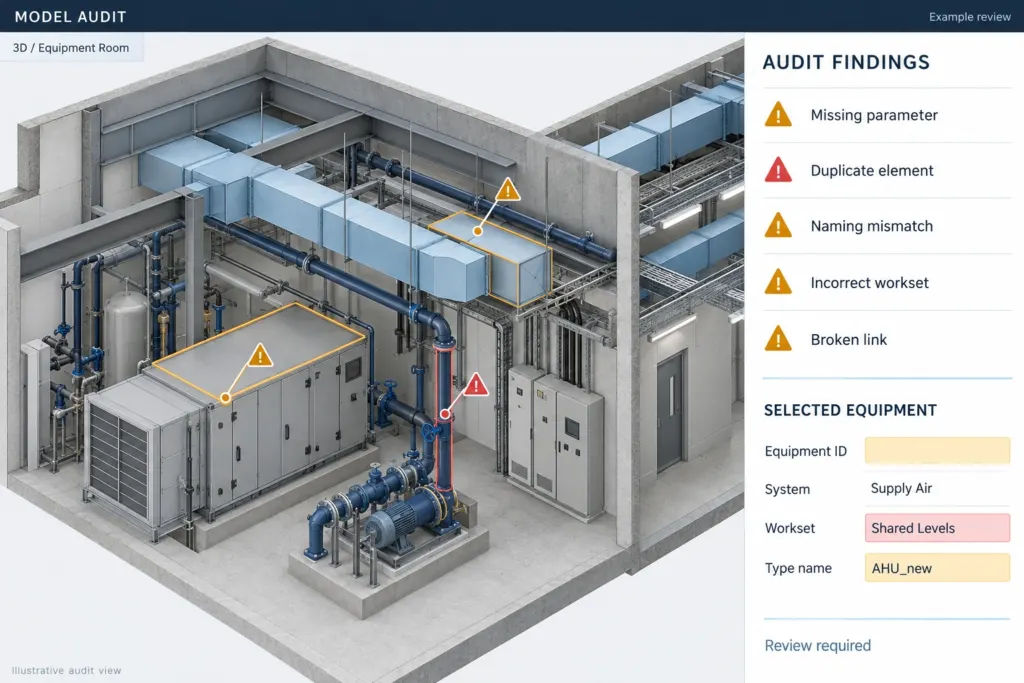
A model may appear correct visually while still containing:
- Missing or incorrect parameters
- Duplicate elements
- Excessive warnings
- Inconsistent naming
- Unapproved families
- Broken links
- Incorrect worksets
- Poor file structure
- Unreliable schedules or extracted information
- Submission-readiness problems
What ADES delivers
Ten deliverables, one controlled handoff.
Model-health review
Warnings, duplicates, imports and model hygiene reviewed.
Standards-compliance review
Checked against your BEP and project BIM standards.
Parameter validation
Required and shared parameters checked for completeness.
Naming and classification review
Views, sheets, families and systems named to standard.
Family and content review
Unapproved families, in-place elements and CAD imports flagged.
File and link management
Links, worksets, coordinates and file structure verified.
Model cleanup
Corrections made to the agreed requirements.
Delivery-readiness checks
Required content, naming and metadata confirmed.
Issue and QC records
Every finding recorded with an owner and status.
Versioned release packages
Package ID, revision and release status documented.
What we need from you
The inputs we work from.
Anything missing is logged in the requirements register, never assumed.
How it runs
Delivered through the ADES Delivery System.
The stages and records that apply to this service line.
Requirements
Requirements registerProduction
Production reviewIndependent QC
QC recordRelease
Release recordSupporting automation and model intelligence
Rule-based checks supporting technical review.
ADES develops and applies rule-based workflows to reduce repetitive model tasks, identify preventable errors and strengthen QA/QC. Automated results are reviewed by technical personnel before they influence project delivery.
Automation supports
- Duplicate-element detection
- Required-parameter validation
- Naming and standards compliance
- Data extraction for review
- Repetitive view or model-setup operations
What remains human-reviewed
- Constructability
- Routing decisions
- Design intent
- Access requirements
- Exception handling
- Issue severity
- Final release approval
Controlled outputs
What you receive with every package.
Each release comes with the evidence of how it was checked.
Reviewed Model
Checked against the agreed requirements.
Issue Record
Open, closed and accepted items.
QC Record
Checks performed and reviewer identified.
Versioned Delivery
Package ID, revision and release status.
Validation Report
Supporting report, where applicable.
| Category | Check | Method | Status |
|---|---|---|---|
| Model Health | Duplicate elements reviewed | Automated | Pass |
| Project | Required parameters populated | Automated | Exception |
| Documentation | View naming meets standard | Visual | Pass |
| Coordination | Major hard clashes reviewed | Coordination | Open |
Intended outcomes
What it means for your project.
Fewer preventable submission problems
More consistent model information
Stronger traceability
Clearer handoff
Less dependence on individual memory
Better readiness for downstream workflows
Outcomes describe intended benefits, not guaranteed results.
When contractors use it
Typical reasons teams bring us in.
- Model review support before submission
- Checks and clean-up of models built by others
- Fewer rejected submissions from non-compliant models
- Confidence in third-party models before accepting them
- Reliable model data for downstream stakeholders
- Documented proof of BEP and standards compliance
- Clear version control and release governance
- Team hours recovered through targeted automation
Related experience
Where the founder has done this before.
FAQs
Questions contractors ask.
Other services
Explore the rest of what we do.
BIM Integration
Discipline models built from drawings, point clouds and agreed requirements.
Best for: models built from drawings or scans
MEP Coordination
Trade models brought together, conflicts reviewed and revisions tracked.
Best for: clashes resolved and coordination meetings supported
Get started
Start small. Prove the fit. Then scale.
Begin with one equipment room model or one coordination review cycle, scoped and priced up front.