
The problem
During coordination, an issue may be marked as corrected as soon as an element has been moved in the authoring model. But moving the element only confirms that someone acted on the issue. It does not confirm that the proposed correction works within the complete coordinated model.
A rerouted duct may clear a beam but reduce access to a valve. A shifted pipe may resolve one clash while creating another conflict farther along the run. Equipment may appear coordinated geometrically while its maintenance or removal clearance remains obstructed.
If these changes are not rechecked in the latest federated model, the issue can reappear during the next coordination cycle-or remain hidden until installation begins.
Corrected does not mean closed.
The issue lifecycle
Every coordination issue should move through a defined sequence:
Identified → Classified → Assigned → Corrected → Rechecked → Closed
When an issue is identified, it should first be classified by trade, location, priority and required action. It is then assigned to a clearly named owner rather than left as a general coordination comment.
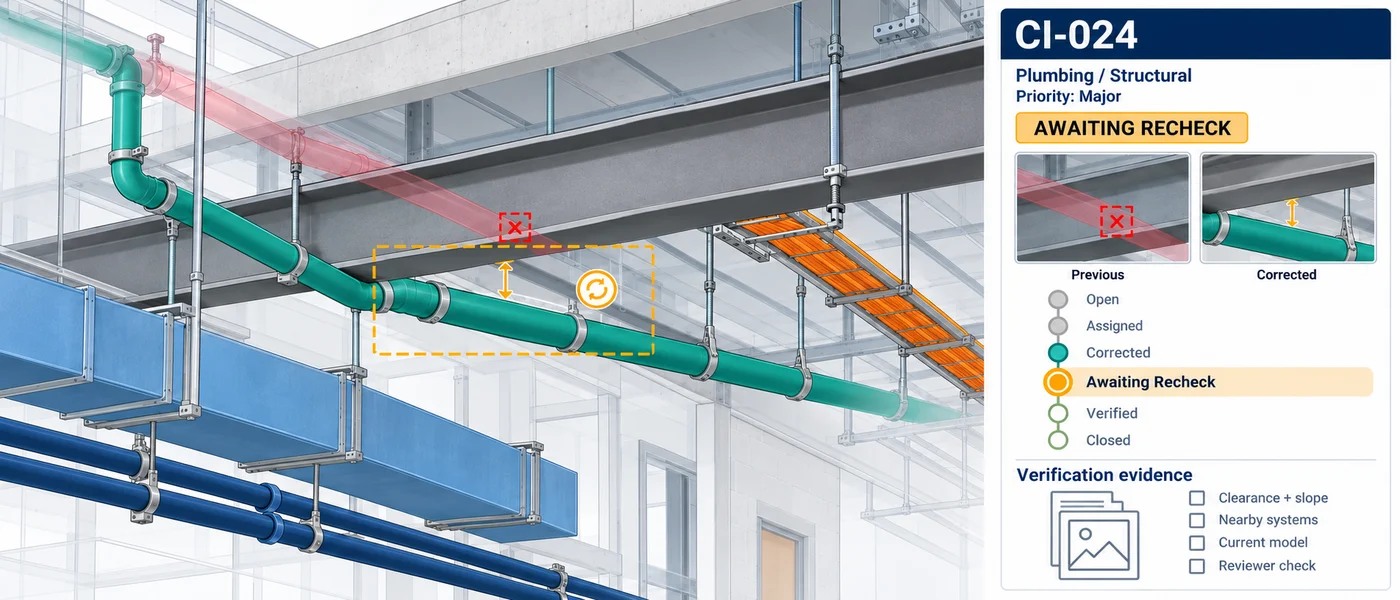
Once the responsible party updates the model, the issue can be marked as corrected. At this stage, the correction is ready for review-it is not yet complete.
The revised model must then be rechecked against the current architectural, structural and trade models. The review should confirm that the original conflict has been resolved without introducing a new clash, affecting access requirements or creating an impractical installation condition.
Only after this verification should the issue be closed. If the correction fails the recheck, it returns to the responsible party with an updated comment and status. Where a conflict cannot be resolved through model changes, it should be documented as an accepted exception with the responsible parties’ agreement.
Why the recheck matters
Consider a chilled-water pipe clashing with a structural beam. The pipe is lowered in the mechanical model, and the original hard clash disappears.
That correction may appear successful when the mechanical model is reviewed by itself. However, after the updated model is federated, the lowered pipe may conflict with a cable tray, reduce ceiling clearance or make a nearby valve difficult to access.
The original clash was corrected, but the coordination issue was not resolved.
A proper recheck reviews the change within its surrounding conditions. Depending on the issue, this may include:
- Hard and clearance clashes
- Access and maintenance zones
- Required slopes and connection points
- Structural and architectural constraints
- Routing continuity
- Installation and sequencing considerations
- Current revisions from the affected trades
This additional step creates a clear distinction between work that has been changed and work that has been verified.
Takeaways
Use separate statuses for corrected and closed.
A model change should move an issue into recheck-not directly into closure.
Assign one owner and retain the issue record.
Each issue should maintain its reference, location, responsible party, comments and status history through the complete coordination cycle.
Verify corrections in the latest federated model.
Closure should confirm that the original conflict is resolved and that the change has not created another coordination, access or constructability problem.
A disciplined issue lifecycle gives contractors a more reliable view of what has actually been coordinated. It also creates a clearer record for coordination meetings, model releases and downstream project teams.
Facing recurring coordination issues on a project?
Start with a clearly scoped coordination package. Prove the fit, then scale.
Facing this on a project? Get a scoped quote.

Prashant Andani, Founder
Hands-on BIM/VDC delivery across infrastructure and building projects.
LinkedIn